
Engaged Study
An Agentic Mindset Intervention
Bolstering students’ orientation for agency, a mindset that views student motivation as flexible and influenced by students expressing their learning needs, is a promising, innovative strategy to address various motivation challenges, including undergraduate students’ persistence in STEM majors.
With funding from the NIH, we are running a large, multi-year experiment in STEM courses at five universities to test the following question: can a program designed to strengthen students' sense of agency improve their academic and psychological outcomes?
This study uses rigorous research methods. Students were randomly assigned to one of two groups including our agentic orientation program and a comparison group that focused on managing test anxiety. Neither students nor instructors knew which group students were in. We also randomly assigned a subset of participating instructors to either take part in a teaching workshop on supporting student motivation or not, allowing us to test the program from both the student and instructor side.
Agentic engagement is when students take an active role in shaping their own education. Instead of waiting passively, they speak up, share their input, and work with their instructors to make learning experiences more useful and meaningful for themselves.
Closely related is an agentic mindset —a student's belief that speaking up and shaping their learning is both possible and worthwhile. This belief helps determine whether students actually use these agentic engagement strategies in class. If students don't believe their input makes a difference, they're less likely to act, even when the opportunity is there.
Prior research has provided evidence that students’ agentic mindset and agentic engagement can transform instructors’ practice to be more supportive, and supports students’ motivation, engagement, and achievement.

The program was short and student-friendly. It included two brief, web-based sessions delivered directly to students. Students were encouraged to see their motivation in STEM classes and the support they receive from instructors as flexible and responsive, something they can actively influence.
The student program involved four key components:
-
Scientific evidence on the benefits of agency for motivation
-
Strategy descriptions with examples of how to implement
-
Prompts for reflection
-
Student and expert testimonials
-
Writing exercises to encourage planning of agentic behavior
Since students' first semester of participation, we have followed up with them yearly to provide them with a refresher, or booster intervention session, of what they learned in the program.

The instructor workshop was built on the principle that students have fundamental psychological needs for autonomy, competence, and relatedness that underlie their motivation, engagement, and well-being. Therefore, instructors can help support students’ motivation and engagement by adopting strategies that bolster students’ sense of autonomy and related psychological needs.
Instructors in our workshop completed two sessions before the start of the course: one online session they could do on their own time, and one live session with our research team and fellow instructors. Throughout, instructors were encouraged to reflect on how to better support their students by promoting autonomy in the learning process.
The instructor workshop involved six key components:
-
Science based information on the benefits of support for psychological needs
-
Strategy descriptions with examples of how to implement
-
Prompts for reflection
-
Discussion with peers
-
Action plan worksheet to outline implementation plan
-
Ongoing feedback and coaching

Participants were college students and their instructors in introductory STEM courses.
Participating universities included the University of Southern California, University of Michigan, Texas State University, University of Texas at Austin, and California State University, San Bernardino.
Participating students were 19.6 (SD = 3.9) years old on average and 71% female. Students were 29% first-generation college students.
Students in our sample identified as*:
-
9.6% Black/African American
-
24.3% Hispanic Latino
-
1.2% American Indian/Alaska Native
-
32.4% Asian/Asian American
-
42.1% White/European American
-
0.5% Native Hawaiian/Pacific Islander
-
5.8% Middle Eastern/North African
*Students could select more than one group, so percentages do not equal 100%


Undergraduate students completed two brief intervention sessions, one at the start of the semester and one at the middle. They also completed three surveys throughout the semester.
After students' first semester of participation, they are invited to participate in yearly follow-up sessions. These follow-ups, or booster intervention sessions, have included a strategy review sheet, open-ended reflection questions, and a brief diagnostic assessment.
Instructors, regardless of their condition, submitted three class recordings and completed a baseline and end of semester survey. Instructors in the workshop condition also participated in two training sessions and received regular coaching throughout the semester.
The timeline to the right shows an example schedule for participants in a fall semester course.
This study is still ongoing. We are following students from their very first semester in the program all the way through to graduation, so that we can understand the program's long-term impact on outcomes like graduation, staying in their chosen major, completing courses, and GPA.
In the meantime, we have analyzed the data we have and already have some encouraging preliminary results.
So far, we've found that:
-
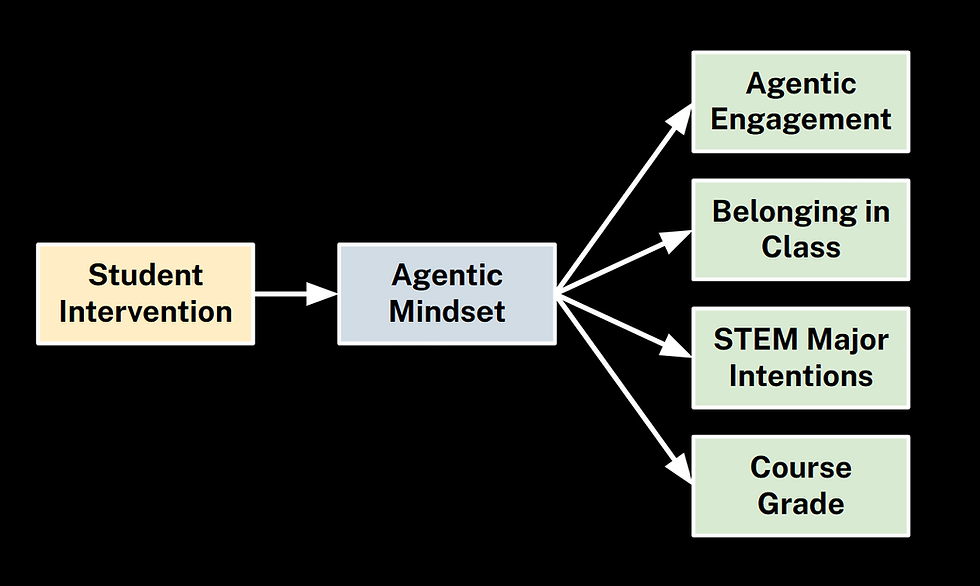
The agentic orientation program led to increases in students' agentic mindset
-
Stronger mindset, in turn, was linked to higher course grades, a greater sense of belonging in class, more active engagement in class, and stronger intentions to pursue a STEM major, among many other positive outcomes
-
These benefits were consistent across students — they did not differ based on whether a student identified as an underrepresented minority in STEM
Principal Investigator: Erika Patall, PhD, University of Southern California
Co-Principal Investigators:
-
Carlton Fong, PhD, Texas State University
-
Germine Awad, PhD, University of Michigan
-
Keenan Pituch, PhD, Arizona State University
Postdoctoral Scholar: Amanda Vite, PhD, University of Southern California
Co-Investigators:
-
Christa Bancroft, PhD, University of Southern California
-
Kristy Daniel, PhD, Texas State University
-
Timothy McKay, PhD, University of Michigan
-
Stephen Aguilar, PhD, University of Southern California
-
Kevin Cokley, PhD, University of Michigan
Current Graduate Research Assistants:
-
Pedram Zarei, Texas State University
-
Rouan Salim, University of Michigan
-
Lillian Hinojosa, University of Southern California
-
Sihan Wang, University of Southern California
- Cassidy Martin, University of Southern California
-
Carolyn Jess, Texas State University
Previous Graduate Research Assistants:
-
Yanyan Zong, University of Southern California
-
Lillian Nguyen, University of Michigan
-
Diane Lee, University of Southern California
Want to learn more about our research?
We are happy to share our materials with researchers interested in conducting collaborative research. We will also share our materials with practicing educators interested in using materials to support student motivation in their own programs.
We are not distributing materials with those interested in developing commerical products at this time.
Please email the Principal Investigator, Erika Patall, at patall@rossier.usc.edu for more information.
